Innovative solutions in embedded systems, web development, and software engineering. From competition-winning drone swarm systems to Arduino hardware projects and full-stack applications.
Featured Projects
Explore my recent work showcasing technical skills across multiple domains. Click any project to view detailed implementation information.
🚀 FEATURED
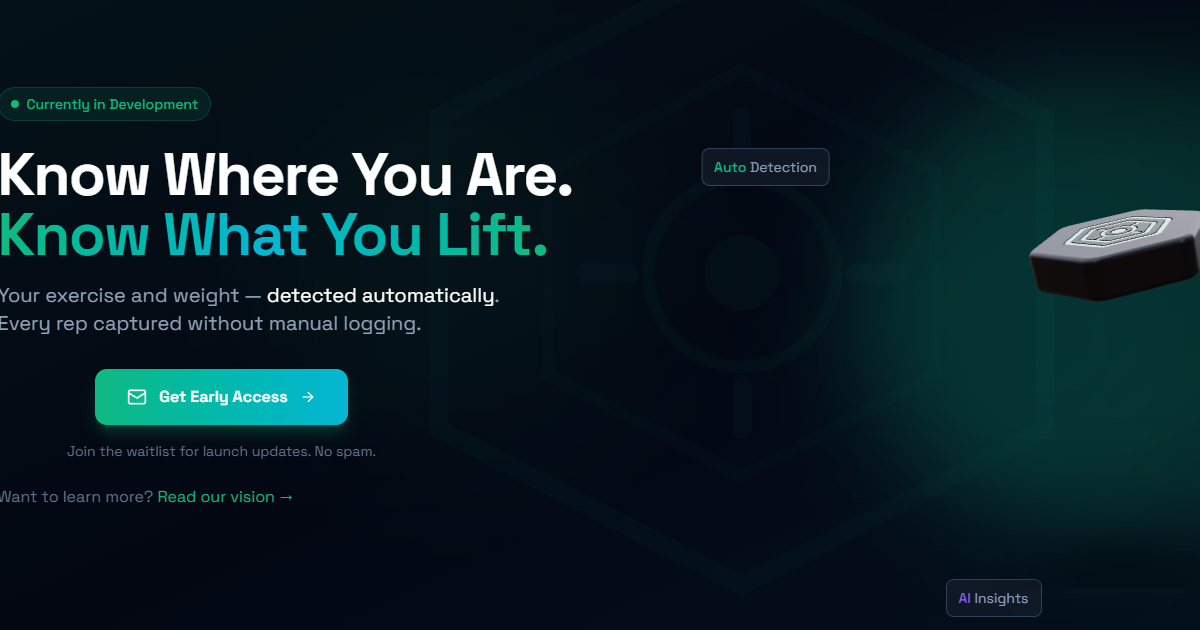
LOCUS FIT
Automatic workout logging that tracks your exercises, weights, and reps, so you can focus on lifting, not typing.
The LOCUS FIT Puck — Automatic workout logging, zero manual input
LOCUS FIT is an automatic workout logging system that eliminates the friction of manual tracking. Simply bring the Puck to your workout, lift, and your exercises, weights, and reps are logged automatically, so you can focus on training, not typing.
The Puck in action — tracking your lifts automatically
The Problem
Manual workout logging is broken. Most fitness apps are abandoned within weeks because entering every set, rep, and weight mid-workout kills momentum and flow. Athletes know that consistent tracking leads to faster progress, but the tools make it too hard to stay consistent.
The Solution
LOCUS FIT uses spatial context technology to understand what you're doing without any input from you. The gym becomes aware of your workout, automatically detecting exercises, counting reps, and tracking weights in real-time.
What You Get
Zero-Friction Logging: No buttons, no typing, no app switching, just lift and go
Automatic Exercise Detection: The system knows what movement you're performing
Precise Rep Counting: Every rep tracked accurately without manual input
Weight Tracking: Automatic detection of the load you're lifting
Progress Insights: See your training history and progress over time
Works Anywhere: Take the Puck to any gym, it works with standard equipment
Current Status
LOCUS FIT is in active development with a working prototype. Currently running a pilot program at Dalhousie University with plans to launch in 2026. The product website is live at locus.fit.
My Role
As the founder and sole developer, I'm responsible for the complete product vision, from hardware design and embedded software to the mobile app and marketing website. This project demonstrates my ability to take a product from concept through prototype to market launch.
Skills Applied
Product Development: End-to-end product design from concept to working prototype
Full-Stack Development: Hardware, embedded software, mobile app, and web development
User Experience: Designing for zero-friction user interaction
Entrepreneurship: Market research, pilot programs, and go-to-market strategy
Red Light Green Light BCI. EEG-controlled survival game demonstration
SURGE BrainHack Fall 2025 (Winner): An innovative EEG-controlled survival game that adapts the classic "Red Light, Green Light" concept into an immersive brain-computer interface experience. Players control their avatar's movement speed using real-time alpha/beta brainwave analysis from OpenBCI EEG hardware.
A survival-mode adaptation where there is no finish line, players must stay alive by not going off-screen while avoiding randomly passing cars. The twist: EEG brain data controls avatar speed, with higher alpha wave activity resulting in faster movement. During red lights, avatars move backwards; during green lights, they move forward. The last player standing wins.
Brain-Computer Interface Implementation
Real-time EEG Processing: OpenBCI Cyton board integration with BrainFlow for live data streaming
Alpha/Beta Wave Analysis: Welch's method for power spectral density analysis of brain waves
Adaptive Control System: Player 1 controlled by real EEG alpha/beta ratio, Player 2 uses simulated values for comparison
Graceful Fallback: Automatic fallback to test mode when no EEG hardware is detected
Real-time Feedback: Live visualization of brainwave ratios and movement speed multipliers
Technical Architecture
Game Engine: Built from scratch using Python and Pygame for real-time rendering
Signal Processing: NumPy and SciPy for EEG data analysis and frequency domain processing
Hardware Integration: BrainFlow library for OpenBCI board communication and data acquisition
Perspective Rendering: Custom 3D perspective system for road simulation and depth perception
State Management: Traffic light finite state machine with randomized timing intervals
Advanced Features
Dynamic Difficulty: Car hazards spawn randomly with varying speeds and positions
Collision Detection: Sophisticated hitbox system accounting for perspective scaling
Visual Effects: Real-time fog rendering, animated traffic lights, and player movement feedback
Dual Player System: Simultaneous control for competitive gameplay (A/D vs Arrow Keys)
Performance Optimization: Efficient sprite caching and scaling for smooth 60fps gameplay
EEG Signal Processing Pipeline
Data Acquisition: 250Hz sampling rate from 8-channel EEG headset
Preprocessing: DC offset removal and artifact filtering
Frequency Analysis: Real-time FFT processing for alpha (8-12Hz) and beta (12-30Hz) band extraction
Ratio Calculation: Alpha/beta power ratio computation with fallback mechanisms
Movement Translation: Direct mapping of brainwave ratios to movement speed multipliers
Development Achievements
Complete Game Development: Built entire game engine from scratch in Python within hackathon timeframe
BCI Integration: Successfully implemented real-time brain-computer interface with OpenBCI hardware
Team Collaboration: Led technical development while collaborating with Paras on BCI implementation
Problem Solving: Overcame real-time signal processing challenges and hardware integration issues
Innovation: Created novel application of BCI technology for interactive gaming
Skills Demonstrated
Brain-Computer Interface Development: EEG signal processing, real-time data analysis
Game Development: Physics simulation, collision detection, real-time rendering
Signal Processing: FFT analysis, frequency domain filtering, power spectral density
Hardware Integration: OpenBCI board interfacing, serial communication protocols
Python Programming: NumPy, SciPy, Pygame, real-time system development
Team Leadership: Technical project coordination and collaborative development
Technologies Used
Python, Pygame, NumPy, SciPy, BrainFlow, OpenBCI Cyton Board, EEG signal processing, real-time data visualization, and competitive game design principles.
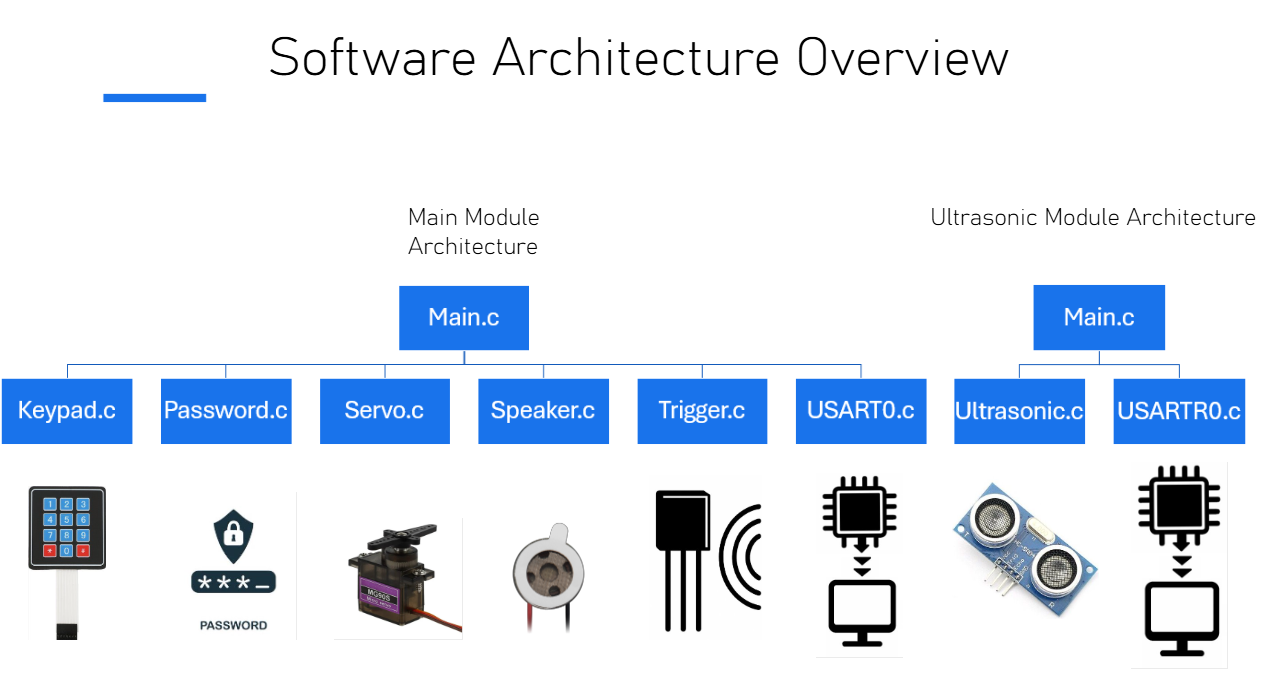
This project implements a microcontroller-based security system with sensor inputs and audible/visual alerts.
See the full design write-up for specifications, design decisions, and evaluation results.
Architecture
Microcontroller platform
Sensor inputs (e.g., motion/door)
Output actuators (e.g., buzzer/LED)
Arming/disarming and alert logic
Key Features
Real-time monitoring and alerting
Simple state machine to handle system modes
Modular design to add or modify sensors
Testing & Validation
Functional tests cover normal, triggered, and reset conditions. Timing and debounce behavior are verified to ensure reliable activation without false alarms.
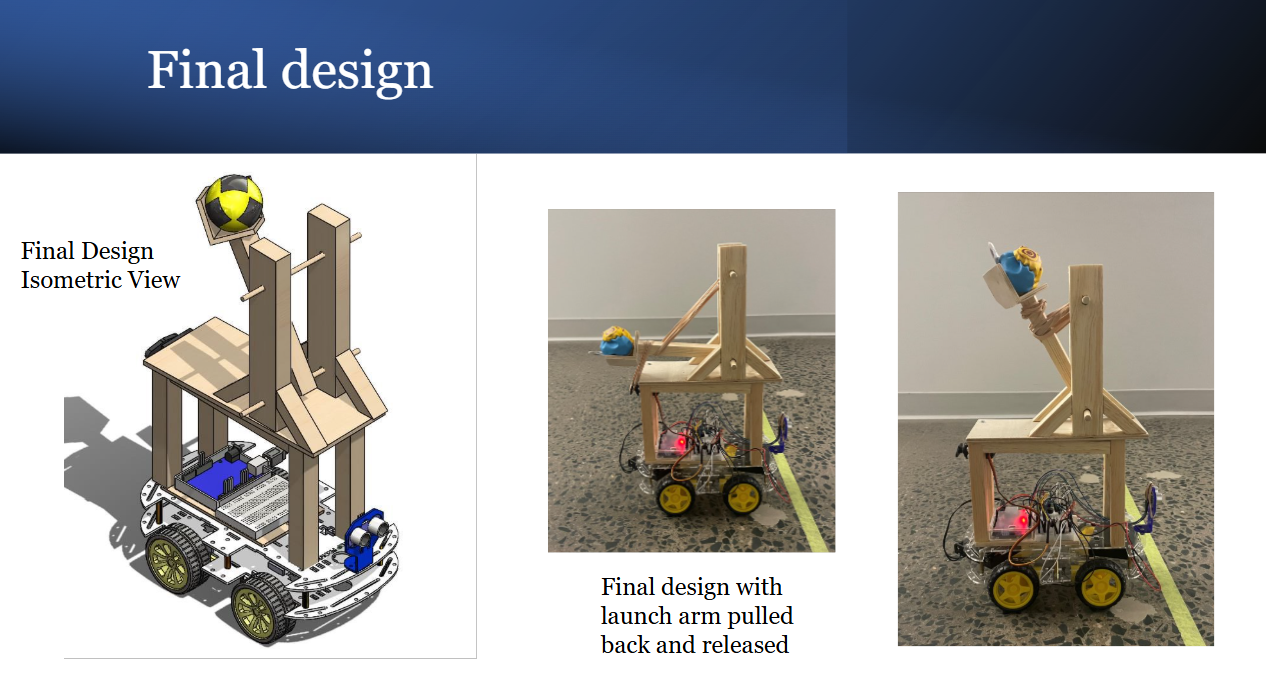
A precision-engineered projectile launching system controlled by Arduino microcontroller with servo-driven targeting and release mechanisms.
This project demonstrates mechanical engineering principles combined with embedded systems programming for automated control and targeting accuracy.
Architecture
Arduino microcontroller platform with servo control libraries
Servo motors for azimuth and elevation positioning
Release mechanism with timing control
Optional targeting system with distance sensors
User interface for manual control and automated sequences
Key Features
Precise angular positioning using servo feedback
Programmable launch sequences and targeting patterns
Safety interlocks and controlled firing mechanism
Modular design for different projectile types
Real-time control via serial interface or wireless communication
Testing & Validation
Accuracy testing across multiple distances and angles, repeatability analysis for consistent targeting,
and safety validation to ensure controlled operation. Performance metrics include launch consistency,
targeting precision, and mechanical reliability under repeated use.
Library Catalog
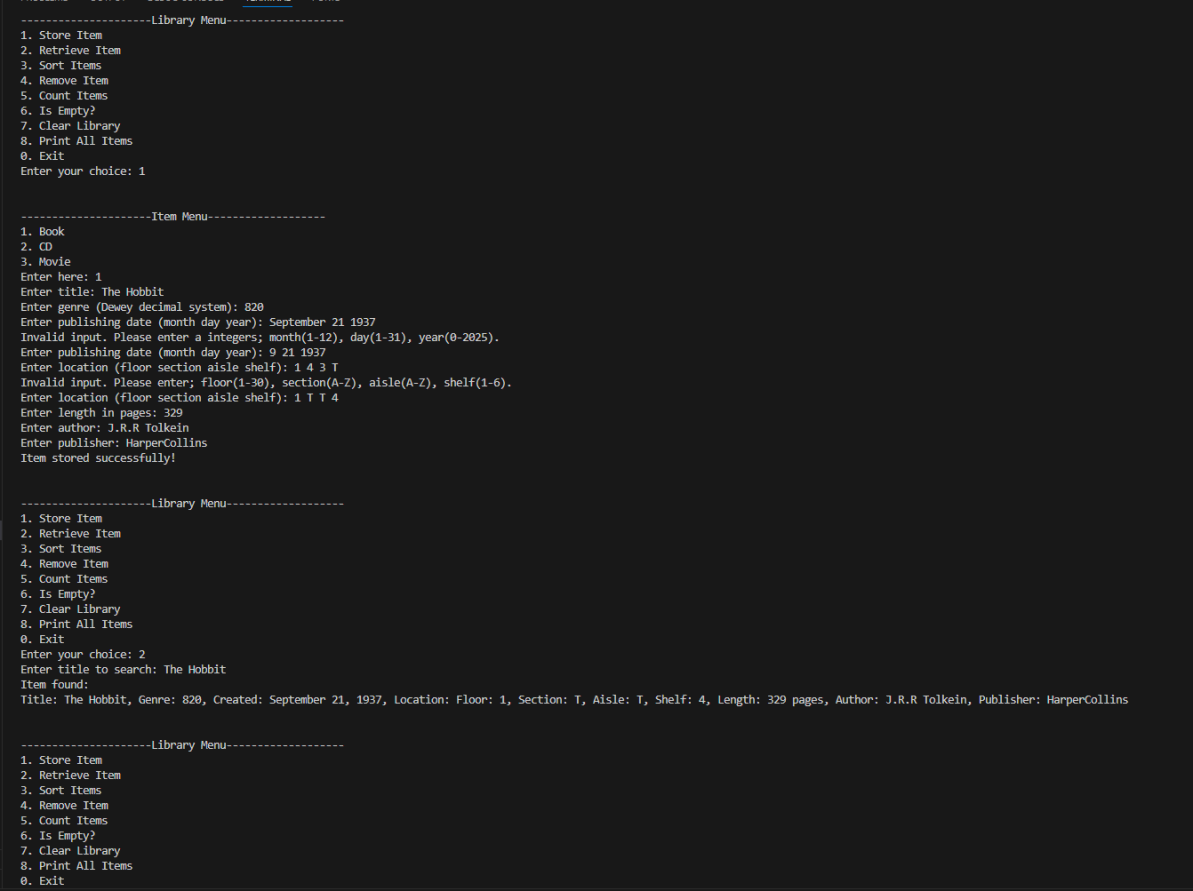
Library Catalog. List and detail views
Overview
A lightweight cataloging system to manage books, authors, and categories with fast search and clean list/detail pages.
Built to demonstrate structured data modeling, CRUD workflows, and CLI.
Architecture
Core entities: Book, Author, Category/Genre
CRUD flows for create, edit, delete, and view
Search and filter pipeline across title, author, and tags
Key Features
Keyword search with sort and filter
Clean list, detail, and edit forms
Validation for required fields and data consistency
Testing & Validation
Verified create/edit/delete flows, and search accuracy. Focused on usability and data integrity under typical usage.
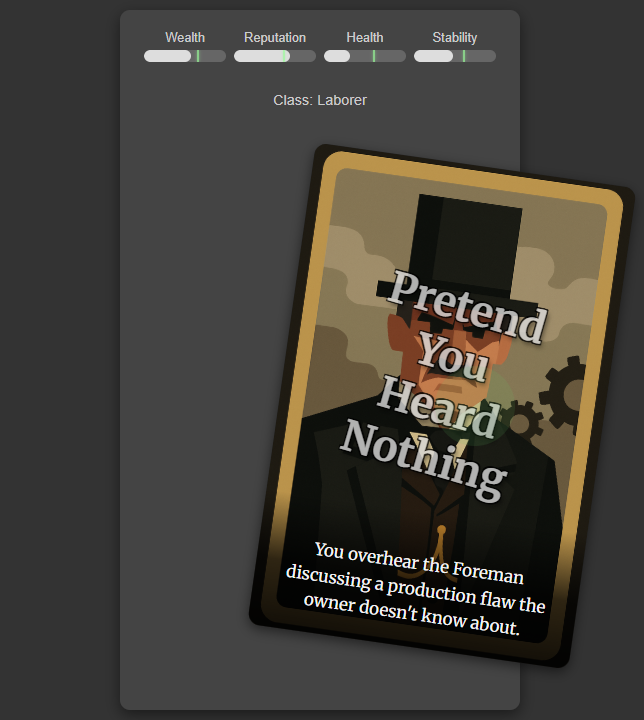
Generations: Industrial Revolution. Card and stats UI
An elegant, swipe-choice narrative strategy game set in the Industrial Revolution. Balance four competing societal stats, climb the social ladder across generations, and survive the consequences of your decisions.
A minimalist, mobile-friendly, card-driven game where every left/right choice shifts Wealth, Reputation, Health, and Stability. Pushing you toward ascension or collapse.
Overview
Core loop: Drag or swipe a card left/right to choose; each choice alters multiple stats and advances the story.
Multi-class progression: Start as a Laborer and, by hitting thresholds, ascend to Merchantile, Noble, and ultimately Royalty.
Tight balance: Let any stat drop too low (or, for some classes, soar too high) and you trigger unique failure states and endings.
Session-based play: On death or dynasty end, review your outcome and tap “Live Again” to restart instantly.
Core Mechanics
Stats:Wealth, Reputation, Health, Stability with visible bar fills and threshold markers for next/previous milestones.
Classes & thresholds: Each class defines ascension requirements and maximum bar sizes. Threshold markers help you plan risks and rewards.
Card choices: Narrative cards present two options; outcomes are tuned per class via tags (e.g., laborer, merchantile, noble, royalty, opportunity, danger).
Endings: Distinct end screens with title, message, and optional imagery; restart is one click.
Implementation Highlights
Stack: HTML5 + CSS3 + Vanilla JavaScript (no frameworks, fully client-side, deploys as static site).
Responsive UI: Fixed 2:3 card aspect ratio, image-first card composition with an overlaid gradient text container and large choice hints.
Polished feedback: Subtle drag transforms, left/right swipe feedback halos, and animated stat bar updates.
Thematic typography: Google Font Merriweather for narrative text; clean sans-serif for UI elements.
Config-first design: Central class definitions and thresholds in script.js gate content and progression via card tags.
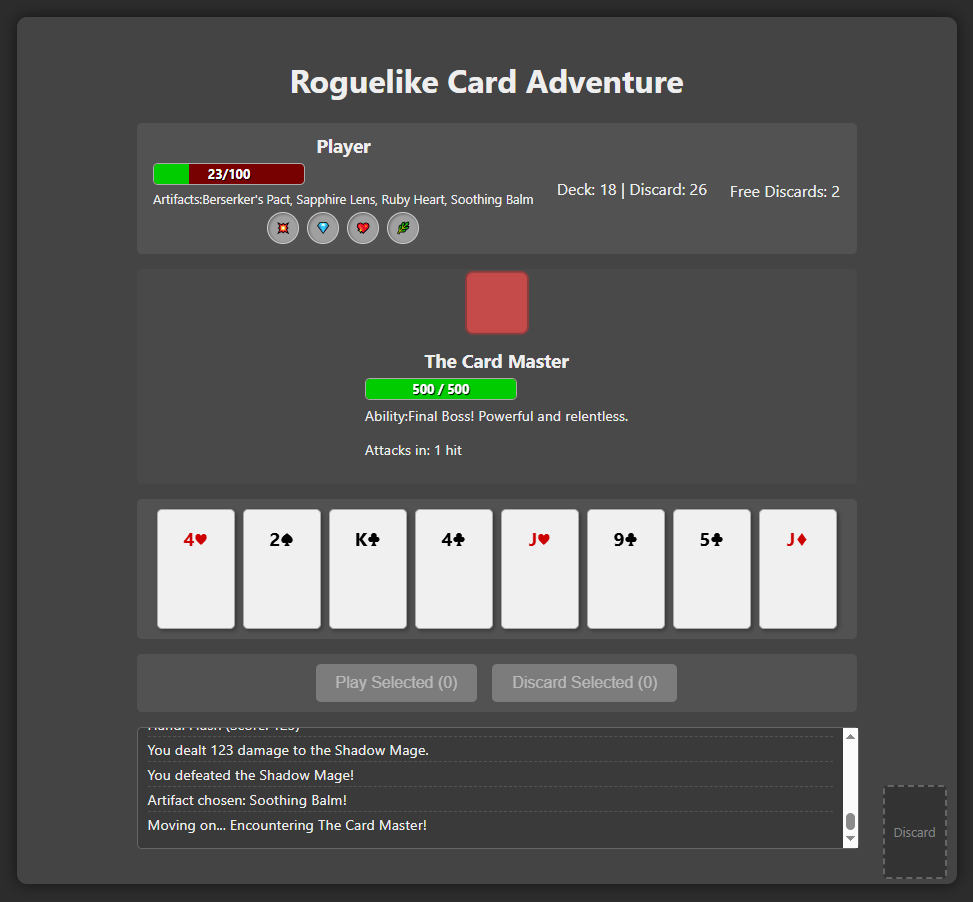
Roguelike Card Adventure. Poker combat and artifact UI
A sophisticated web-based roguelike card game that combines traditional poker mechanics with strategic artifact collection and enemy encounters. Built with pure HTML5, CSS3, and vanilla JavaScript.
Roguelike Card Adventure is a single-page web application inspired by Balatro that challenges players to defeat enemies using poker hands formed from playing cards. The game features a progressive difficulty system, collectible artifacts that modify gameplay mechanics, and smooth CSS animations for enhanced user experience.
Core Gameplay Mechanics
Poker-Based Combat System: Players form traditional poker hands (Royal Flush, Straight, etc.) to deal damage
Strategic Card Management: 8-card hand limit with deck shuffling and discard pile mechanics
Progressive Enemy Encounters: 5 unique enemies with distinct AI patterns and special abilities
Artifact Collection System: 9 unique artifacts that modify game rules and provide strategic depth
Technical Highlights
Pure Vanilla JavaScript: No frameworks or libraries - demonstrates strong foundation in core web technologies
Responsive CSS Design: Flexbox-based layout with mobile-friendly responsive design
Advanced CSS Animations: Keyframe animations for card movement, damage indicators, and visual feedback
Modular Architecture: Clean separation of game logic, UI management, and animation systems
State Management: Comprehensive game state system handling multiple game phases
Advanced Systems
Dynamic Hand Evaluation: Complex algorithm evaluating poker hands with artifact modifications
Animation Queue Management: Smooth transitions and visual feedback for all player actions
Damage Calculation Engine: Multi-layered system incorporating base damage, hand scores, and artifact bonuses
Enemy AI Patterns: Unique attack patterns and special abilities for each enemy type
Game Features
Combat System: Royal Flush (250 damage), Straight Flush (150 damage), Four of a Kind (100 damage)
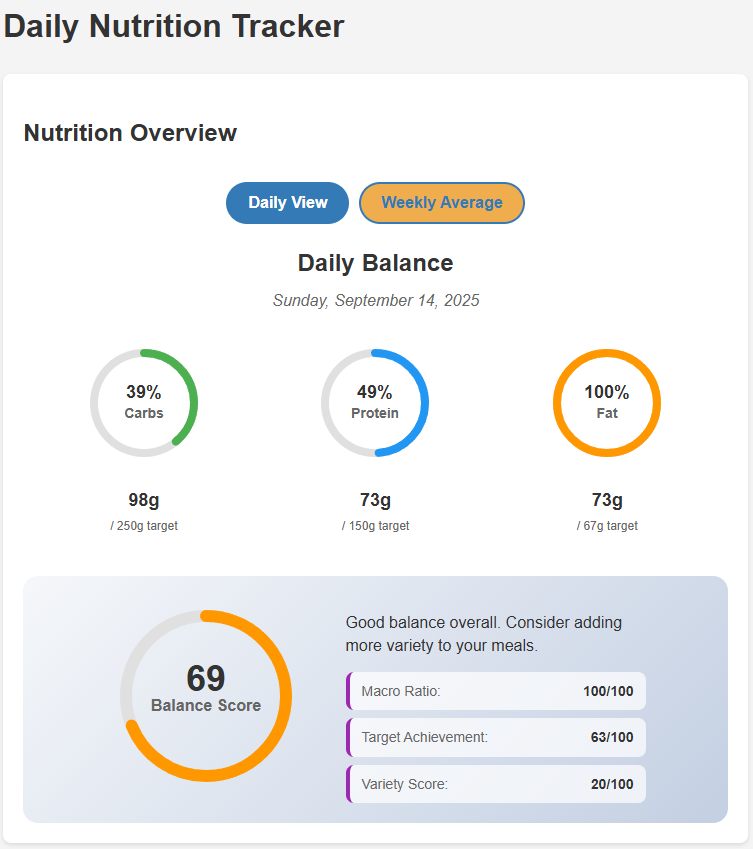
Daily Nutrition Tracker. Progress rings and analytics dashboard
A comprehensive web-based nutrition tracking application built with vanilla JavaScript, featuring interactive data visualizations and persistent local storage.
The Daily Nutrition Tracker is a full-featured single-page application that helps users monitor their daily nutritional intake through an intuitive interface with real-time visual feedback. The app demonstrates proficiency in front-end development, data management, and user experience design.
Key Features
Interactive Data Visualization: SVG-based animated progress rings for macronutrients with real-time updates
Balance Score Algorithm: Intelligent scoring system based on macro ratios, target achievement, and dietary variety
Persistent Storage: Client-side data persistence using localStorage API with data integrity validation
Responsive Design: Mobile-first CSS Grid layout with smooth animations and intuitive navigation
Technical Implementation
Frontend Technologies: JavaScript (ES6+), CSS3, HTML5, SVG with modern features like arrow functions and template literals
Architecture Patterns: Component-based structure, event-driven programming, centralized state management
Data Structures: Nutritional calculations with precision handling, efficient sorting and search algorithms
Ingredient Management: Dynamic ingredient creation with validation and automatic per-gram nutrition calculation
Meal Composition: Create reusable meals from multiple ingredients with automatic nutritional aggregation
Daily Logging: Date-specific food entries with historical tracking and running calculations
Analytics Dashboard: Progress tracking with multi-factor balance scoring and contextual feedback
Skills Demonstrated
Problem Solving: Complex nutritional calculation algorithms with mathematical precision
Data Modeling: Efficient relational data structures and normalization
Browser APIs: localStorage, Date API, advanced DOM manipulation
Code Quality: Clean, maintainable, well-documented code with defensive programming
Technologies
JavaScript ES6+, HTML5, CSS3, SVG, localStorage API with mobile-first responsive design and progressive enhancement.
PaddleApp - Dragon Boat Team Management iOS Application
PaddleApp Logo
Work in Progress: A comprehensive iOS application designed for dragon boat racing teams, providing seamless team management, athlete coordination, and coaching tools. Developed in collaboration with SoftX Innovations as part of their product suite.
Overview
PaddleApp is built with modern SwiftUI architecture and Firebase backend integration, demonstrating full-stack mobile development capabilities with real-time data synchronization. This project showcases advanced iOS development skills while serving as a foundation for SoftX Innovations' sports team management solutions.
Key Features & Achievements
Advanced Authentication System: Firebase Authentication with role-based access control for Athletes and Coaches
Team Management Platform: Team creation, smart joining via unique IDs, and real-time roster updates
Dynamic Dashboard System: Performance analytics with circular statistics for distance, stroke rate, and speed metrics
Real-time Features: Live team member updates using Firestore listeners with instant UI synchronization
Architecture: MVVM design pattern with clean separation of concerns and protocol-oriented programming
Custom Components: Reusable UI library including InputView, TeamCardView, and StatisticCircle components
Data Management: Real-time synchronization with comprehensive error handling and validation
Development Status & Collaboration
Currently in active development as part of a collaboration with SoftX Innovations, this project serves as both a learning experience in professional iOS development and a foundation for commercial sports management applications. The codebase demonstrates production-ready development practices with proper state management and scalable architecture.
Software Engineering: Clean code architecture, component-based design, Git version control
Professional Collaboration: Working with external development teams and commercial product requirements
Future Development
Planned enhancements include real-time chat systems, GPS-based activity tracking, advanced performance analytics, push notifications, and social team features. The app will continue evolving.
Dalhousie Engineering Competition Programming Category (Winner): Autonomous firefighting drone swarm simulation and visualization for Nova Scotia, built from scratch for the Dalhousie Engineering programming competition. Selected and funded by Dalhousie Engineering Society and Dalhousie Student Union after meeting competition criteria.
A complete prototype system for firefighting drone swarm behavior, mapping, and visualization. The project simulated how a group of drones would explore a 550×300 grid, discover fires from limited local observations (1-tile radius), and influence an external environment file by dropping water. Built for the Dalhousie Engineering competition with no starter code provided our team implemented the full stack from first principles.
Environment Data Format
The competition specified that each map tile would be encoded as a fixed-length string where:
Position encoding: 3 digits for x-coordinate (0-549), 2 digits for y-coordinate (0-299)
Fire & weather: Fire severity (0-9), wind speed, wind direction (0-3)
Entities: Citizen flag, firefighter flag, turns-since-seen, trust value
Constraint: Drones could only act on tiles discovered through their 1-tile radius scan per round
Technical Challenges
Zero Blueprint Design: No starter code or framework provided; designed encoding/decoding, mapping, drone scanning rules, and visualization from first principles
Limited Observability: Drones operated with 3×3 vision windows per round, requiring intelligent exploration and memory management
Interoperability: Python agent had to interface with coordinators' C environment writer (format mismatches prevented real-time integration during competition)
Performance Visualization: 550×300 grid with dynamic overlays required careful Matplotlib artist reuse to avoid repaint overhead
My Role Lead Visualization Developer & System Integrator
As the visualization lead, I developed the complete interactive GUI showing historical vs predicted fire maps, drone positions, scan windows, citizens, firefighters, and wind vectors. I also helped design data structures and classes for the multi-agent system. Using seeded test data to demonstrate functionality, the visualization system featured:
Fire Severity Heatmaps: Dynamic color-coded severity mapping (0-9 scale) with custom Matplotlib colormaps and transparent unmapped areas
Multi-Drone Tracking: Real-time drone position tracking with historical path logging and 3×3 vision window visualization
Entity Overlays: Citizen and firefighter position markers with real-time updates
Wind Vector Display: Directional indicators showing fire spread dynamics
Animated Rendering: In-place Matplotlib artist updates for performance, avoiding full repaint overhead on large grids
GIF Export System: 1680×504 resolution output with background basemap support and rotation
Competition Outcome: Judges and coordinators specifically praised the visualization work as a standout element. While our Python program encountered format/interop issues with the coordinators' C environment runtime during competition, the visualization successfully demonstrated our system's intended functionality using seeded data. Post-competition, I ported the Python code to C++ and produced a working integrated demo.
System Architecture
Our team implemented a modular design with specialized components:
Grid System: Efficient tile encoding/decoding with compact 14-character format per cell
Fire Dynamics: Deterministic spread model with downwind propagation based on wind direction
Drone AI: State machine with scouting, targeting, extinguishing, and refilling modes
Multi-Drone Coordination: One drone per base station with intelligent severity-based targeting (≥4)
Data Persistence: Per-round map archives, vision logs, and drone path CSVs
Visualization System: My focus interactive GUI with historical/predicted maps and entity tracking
Post-Competition C++ Port Functional implementation with organizer framework integration
Post-Competition Development C++ Port
After the competition, I independently ported the entire Python codebase to C++20 to validate our approach and achieve full integration with the coordinators' environment framework. This post-competition work involved:
Complete Language Migration: Translated all Python classes and algorithms to modern C++20
Build System Setup: Configured CMake with MSVC/MinGW/Clang support and PowerShell build scripts
Framework Integration: Successfully interfaced with the C environment generator after resolving format mismatches
Enhanced Drone AI: Water capacity management with automatic refill, path logging, and vision recording
Performance Optimization: Leveraged C++ efficiency for faster simulation cycles and real-time rendering
Working Demo: Produced fully functional integrated system demonstrating autonomous multi-drone coordination
Atlantic & Canadian Engineering Competition
Building on this success, our team is advancing to the Atlantic Engineering Competition, where we will compete to earn our spot representing the Atlantic region at the Canadian Engineering Competition. This progression demonstrates the quality and innovation of our work.